
It can be tricky to build financial models when you don't have any underlying financial statements, reports, or figures that you can use to build the fundamental assumptions that your model will be based on, but there is hope!
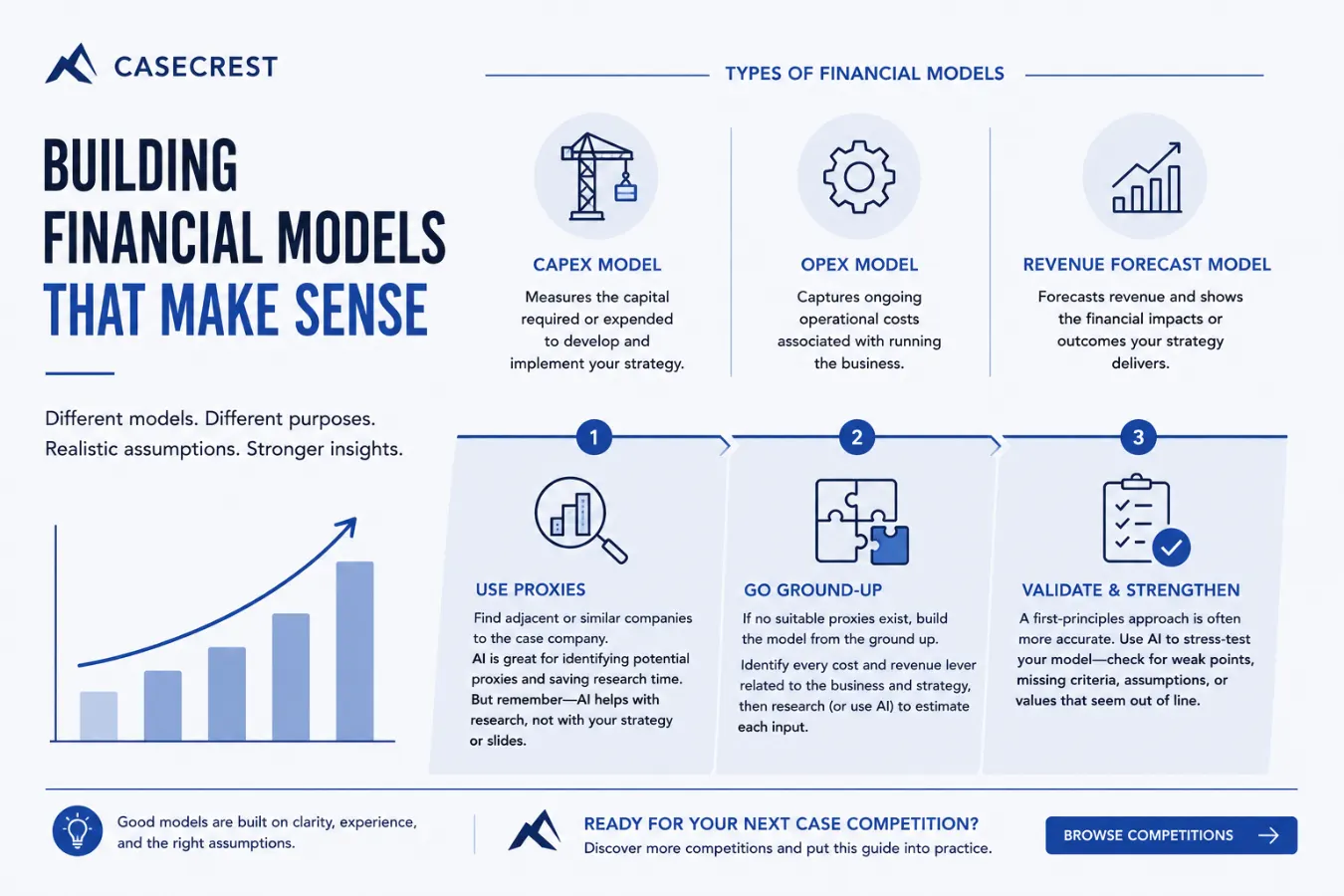
Not all financial models are made equal, and each serves a different purpose. Perhaps it's a CAPEX model to measure how much capital will be required or expended during your strategy's development and implementation. An operational/OPEX model, or even a revenue forecasting model, which will actually show the impacts or outcomes that your strategy delivers from a pricing perspective.
However, in order to create financial models that are realistic, they do need to be based real-world assumptions, ideally that are verified and trustworthy. You should also have a good sense or feel for these numbers that do come with experience and time as you digest more financial information and creating your own models.
Getting to the point, the best way to find assumptions or financial figures when they're missing from the case brief itself is to use proxies. Proxies are essentially adjacent or similar companies to the case company provided. AI is the perfect use case for this to identify what other companies can be used as proxies as this is the kind of manual time consuming research you sometimes want to be avoiding. However, you don't want to be using AI to make your slides or coming up with you strategy!
If you can't find any adjacent companies that even are remotely similar to the case company provided. This is when you can instead opt for a ground-up approach, which is going to be a bit more complex and time-consuming. Essentially, you think of every single cost lever that is associated with that kind of business and the strategy you're planning to implement, and then go manually researching or alternatively use AI to find out what each of these could be priced at.
If it's a digital transformation strategy, you would look at the rough amount of engineers required to implement it, the salary ranges based on geographic location and experience and model it entirely from the ground up. This can be time-consuming and tricky, but it is often some of the most accurate modelling, as you're going from a first-principles approach. You can also be more exhaustive and have AI evaluate it for any weak points, missing criteria, or assumptions, or things that might not be in line or out of line.